Notebook Clues and Exploration
Finding Your Way
How to use Sophia's crew notebook, how the island's chapters are structured, and what to do when the route stops being obvious.
Info checked · September 5, 2026
Short answer: exploration in Resonance runs on two things — the crew notebook, which is the game's own hint system, and your willingness to read a room instead of trying every door. The island is a designed maze, chapters split into replayable subchapters, and collectibles are organised per chapter, so nothing you miss on a first pass is lost for good.
Why the notebook exists
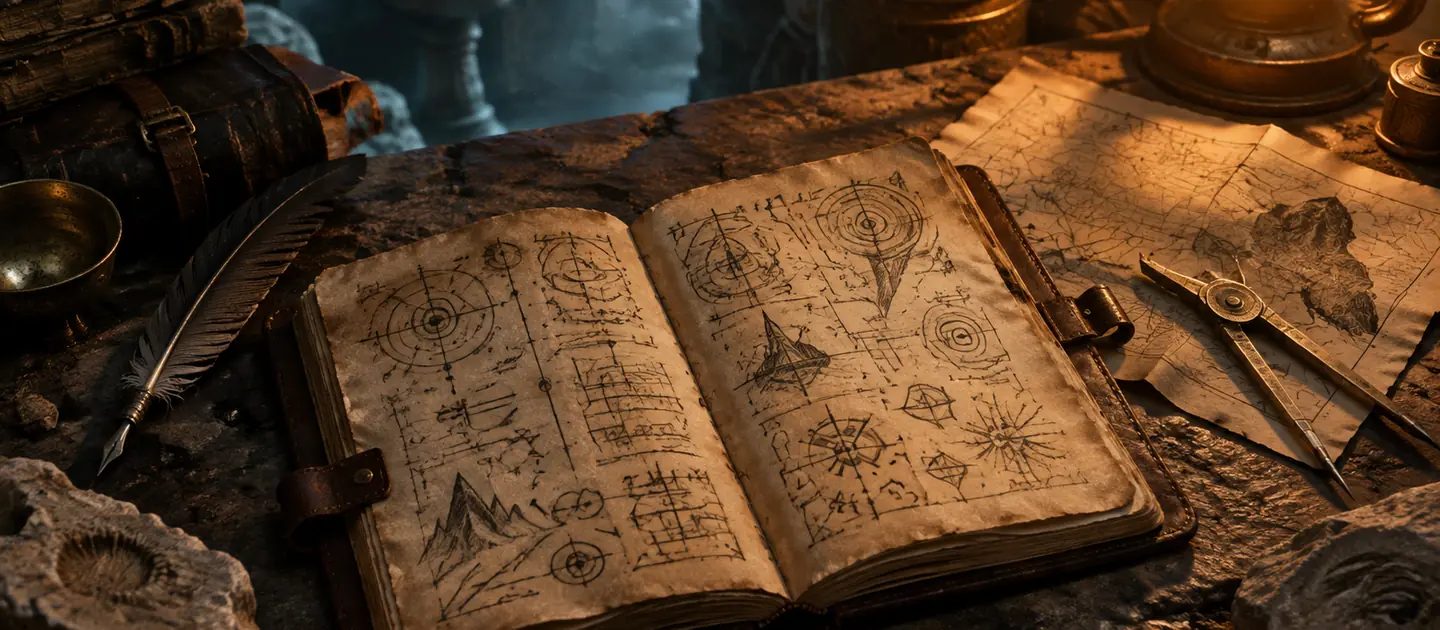
Sophia navigates for a living. As captain of The Rascasse she is described as a master pilot and navigator who treats her work as a technical process involving tools, maps and her crew notebook. The game hands you that habit rather than a quest marker for everything.
So when a route dead-ends, open the notebook. It holds the clues Sophia has gathered so far, and it is the intended answer to being lost. Her own summary of how she works — wake up early, observe, listen, and make the best of it — is a fair description of what the game asks of you too.
Whether the notebook updates automatically or has to be consulted for specific objectives, and whether it tracks collectibles, is to be confirmed.
Read the island
Pair the notebook with observation. The island rewards noticing what is lit, what is broken, and what has been moved or is out of place — the same three questions that solve most of its light puzzles.
Three practical habits:
- Look up and down before looking sideways. Routes here are climbs and squeezes as often as doors.
- Treat light as signage. If a space has been deliberately lit or deliberately darkened, that is usually authored, not decorative.
- Read the architecture. The maze is credited in the fiction to Daedalus, which means the level design is diegetically supposed to trick you — and that a route you cannot see usually exists.
One character detail worth carrying with you: Sophia has a fear of heights. It is a personality trait from the wider series material rather than a confirmed mechanic, so whether it shows up as anything you play — a wobble, a prompt, a scripted moment — is to be confirmed.
Exploring while something hunts you
A restless presence stalks the island's depths, tracks Sophia's movement and forces a steady pace. That single design decision changes exploration more than any map feature: you are searching under a clock you cannot see.
The practical consequence is to explore in passes rather than sweeps. Take what is on your route, note what is not, and come back with the structure below rather than standing in a dangerous room deciding.
The chapter structure, and why it matters for cleanup
Press and community listings describe 14 chapters, each divided into subchapters so you can replay a specific section instead of a whole chapter. That is aggregated reporting rather than an official list, and the full chapter-by-chapter breakdown lives on our chapters page so it stays in one place.
What matters here is how you use it. The subchapter is the unit of replay, which makes it the practical index for backtracking:
- Note the subchapter name when you see something you cannot reach, not just the chapter.
- Finish the chapter first. Backtracking mid-chapter costs you tempo against the hunter; replaying a subchapter later costs you nothing.
- Expect the island's larger set pieces — workshops, mechanisms, arenas — to be poor candidates for casual sweeping and good candidates for a dedicated cleanup pass.
Collectibles
Collectibles are organised per chapter, which is exactly why the subchapter breakdown is useful for cleanup runs. Community listings are built around that structure, and a community mod exists that displays a chapter 1–14 collectible progress panel on screen — indirect but solid evidence that the game tracks collection per chapter.
What we do not have: total counts per chapter, the categories they fall into, where individual items sit, and whether any are missable. All to be confirmed. We would rather ship a partial list we have checked than a complete one we have copied — a wrong missable warning is the kind of error that costs someone an entire second playthrough.
If you are running for completion now, the honest advice is: play the chapter, then use the chapters list to plan replays, and do not trust any per-chapter total you find until it has a source attached.
When you are properly stuck
- Re-read the notebook entry for the current objective.
- Look for a light source you have not used.
- Check whether the way forward is a climb or a squeeze rather than a door.
- Ask whether the obstacle belongs to the other timeline — actions in the ancient past change the paths open in the present.
- Keep moving while you think — the island does not pause for you.
Still to be confirmed
Whether there is a map or fast travel, per-chapter collectible totals and categories, whether any collectibles are missable, whether the notebook tracks collection, and how much of the island can be revisited freely within a chapter. Each goes up when it is verified, not before.